How RFID Helps Healthcare Providers Track and Secure High-Value Medicines
High-value medicines including oncology drugs, biologics, speciality injections, vaccines and other critical treatments—require careful control throughout their lifecycle. A misplaced, expired or unaccounted-for medicine can create financial losses, interrupt patient care and increase compliance risks.
Traditional inventory processes often depend on barcodes, manual registers or spreadsheet-based reconciliation. These methods can work, but they require employees to scan or enter each item individually. In busy hospitals, pharmacies and medical warehouses, this can make frequent stock verification difficult.
RFID, or Radio Frequency Identification, provides a faster and more reliable way to identify, count and track high-value medicines.
What Is RFID Medicine Tracking?
An RFID system typically includes:
- RFID tags attached to medicine packs, containers, trays or storage bins
- Handheld or fixed RFID readers
- Software that connects each RFID tag to a medicine record
- A dashboard for inventory, movement, alerts and reporting
Each tagged medicine can be linked with important information such as:
- Medicine name
- Batch or lot number
- Serial number
- Expiry date
- Quantity
- Storage location
- Supplier details
- Purchase value
- Current inventory status
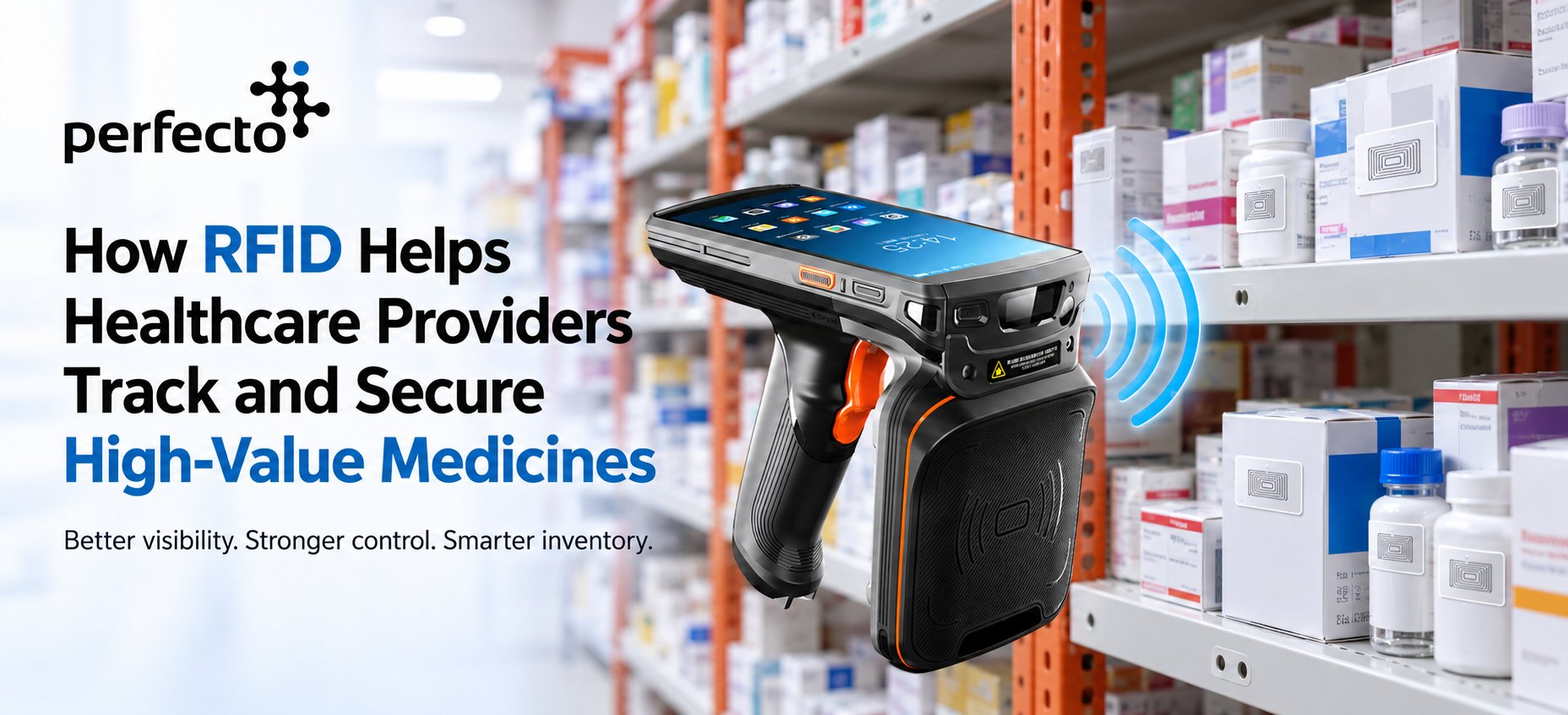
Employees can use an RFID handheld reader to identify multiple tagged items without scanning each barcode individually. Fixed readers may also be installed at selected movement points, such as receiving areas, pharmacy counters or secure storage rooms.
Faster Inventory Counting
Manual stock counting can be time-consuming, especially when a hospital pharmacy manages thousands of medicine packs.
With UHF RFID, employees can count multiple tagged items within the reader’s operating area. This can significantly reduce the time required for daily, weekly or monthly stock verification.
More frequent stock counts can help healthcare providers identify discrepancies earlier instead of discovering them during a monthly or annual audit.
RFID can support:
- Daily stock checks
- Pharmacy inventory counts
- Ward-level medicine verification
- Warehouse cycle counts
- Emergency medicine audits
- High-value cabinet reconciliation
The objective is not only to count faster but also to maintain more accurate and current inventory information.
Improved Visibility of High-Value Medicines
High-value medicines may move through several locations before being administered to a patient. A medicine could travel from a central warehouse to a hospital pharmacy, secure cabinet, treatment department or patient-care area.
RFID can create a digital record of these movements.
Depending on the system design, healthcare teams can see:
- Which medicines were received
- Where they were stored
- When they were moved
- Which department received them
- Whether an item was returned
- Whether the system still considers it available
This visibility makes it easier to locate critical medicines and investigate missing or unaccounted-for stock.
Better Security and Accountability
Expensive medicines require stronger inventory controls because even a small discrepancy can represent a significant financial loss.
RFID can help create accountability by recording medicine movements and connecting them with authorised users, departments or locations. The software can flag unexpected events, such as:
- A medicine leaving a secure area without an authorised transaction
- A mismatch between physical and system stock
- An item being moved to the wrong location
- A returned medicine not being placed back into inventory
- A medicine remaining unaccounted for after reconciliation
RFID does not replace physical security, user permissions or healthcare procedures. However, it can add another layer of visibility to the overall control process.
Expiry-Date and Batch Management
Expired medicines can lead to financial losses and may create patient-safety risks if inventory is not managed correctly.
Because each RFID tag can be connected to batch and expiry information in the inventory system, software can generate alerts for medicines approaching expiry.
Healthcare providers can use this information to:
- Prioritise medicines with earlier expiry dates
- Transfer stock to locations where it is needed
- Reduce unnecessary purchasing
- Separate expired or recalled stock
- Improve First-Expiry, First-Out processes
- Identify affected batches during a recall
RFID identifies the physical item, while the connected software manages its associated batch, expiry and status information.
Reducing Stockouts and Excess Inventory
Poor inventory visibility can cause two opposite problems: stockouts and overstocking.
A stockout may delay treatment, while excess inventory can lock up working capital and increase the risk of expiry. RFID can provide more accurate stock information, helping procurement and pharmacy teams make better replenishment decisions.
With reliable inventory data, healthcare providers can understand:
- Current stock availability
- Consumption patterns
- Minimum and maximum stock levels
- Slow-moving medicines
- Location-wise inventory
- Upcoming expiry exposure
This can support more efficient purchasing and distribution across hospitals, pharmacies and treatment centres.
Supporting Medicine Returns and Recalls
Medicine returns and batch recalls require quick identification.
With barcode-based processes, employees may need to inspect and scan every item individually. An RFID-enabled system can help locate tagged medicines associated with a particular batch, supplier or recall notice.
The system can also change the status of affected medicines to “Blocked,” “Recalled” or “Not for Use,” helping prevent them from being issued accidentally.
A well-designed workflow should still include physical verification and follow the organisation’s applicable regulatory and safety procedures.
Tracking Medicines Across Multiple Locations
Healthcare organisations may manage medicines across central warehouses, hospital pharmacies, clinics, wards and specialist treatment centres.
RFID can support location-wise inventory visibility through a central platform. Authorised teams can view how much stock is available at each location and initiate controlled stock transfers where necessary.
This is particularly valuable for medicines that are expensive, difficult to procure or required urgently.
RFID and Cold-Chain Medicines
Many vaccines, biologics and specialised medicines must remain within defined environmental conditions.
Standard RFID tags identify and track products but do not automatically measure temperature. For cold-chain monitoring, RFID may be combined with temperature sensors, data loggers or specialised sensor-enabled tags.
The complete solution can therefore include:
- Product identification through RFID
- Location and movement tracking
- Temperature monitoring
- Storage-condition alerts
- Cold-chain history
- Exception reporting
The specific design should depend on the medicine, storage requirements and applicable healthcare regulations.
Important Implementation Considerations
RFID performance can be affected by liquids, metals, packaging materials, tag placement and the surrounding environment. Since many medicines are stored in glass vials, foil packaging, liquid-filled containers or metal cabinets, proper testing is essential.
Before implementation, healthcare providers should conduct a pilot covering:
- Suitable RFID frequency and tag type
- Tag placement on different medicine packages
- Reader distance and accuracy
- Performance around liquids and metals
- Integration with existing pharmacy or ERP software
- User roles and access controls
- Data security and privacy
- Exception-handling procedures
- Regulatory and compliance requirements
RFID should be implemented as part of a controlled inventory workflow rather than as an isolated hardware system.
Building a Smarter Medicine Inventory System
RFID can help healthcare providers move from periodic manual stock checks to more frequent and data-driven inventory control.
When connected with the right software platform, RFID can support:
- Faster inventory counting
- Better medicine visibility
- Stronger stock accountability
- Expiry and batch monitoring
- Recall management
- Location-wise tracking
- Reduced stock discrepancies
- Better purchasing decisions
- Improved availability of critical medicines
For high-value medicines, the benefit is not simply knowing how many items are in stock. It is knowing which medicines are available, where they are located, what condition or status they are in and whether any item requires immediate attention.
By combining RFID identification with secure software, clear operational processes and proper system integration, healthcare providers can create a more accurate, efficient and accountable medicine-management system.